Quick answer: Ringlock is a modular steel scaffold with rosette connections, three main component types and load capacity up to EN 12811-1 class 6 duty; it assembles with a single hammer and is the preferred system for complex, high-load access work. Sino East Steel manufactures hot-dip galvanized ringlock standards, ledgers, transoms, braces, jacks and accessories to EN 12811-1 / EN 39 / EN 74 practice with EN 10204 3.1 certificates. Contact us with your working heights and quantities for a container quotation and current production lead time.
Ringlock Scaffolding System
Ringlock Scaffolding System — a factory-direct product from Sino East Steel, one of China’s certified steel manufacturers serving Polish importers, distributors and contractors since 2005. This rosette-based modular system is manufactured to EN 12810 / EN 12811 with a hot-dip galvanized (HDG) finish, supplied with EN 10204 3.1 mill test certificates, and packed for sea freight to Gdansk, Gdynia, Szczecin and other Baltic and Northern European ports. Every order benefits from direct mill pricing, documented quality control and a professional export team that manages documentation, packing and shipping from one source.
This page provides the full technical picture of the Ringlock system — component range, load data, manufacturing background, typical applications, quality assurance, packaging and ordering process — so your procurement team can evaluate the system without chasing data across multiple suppliers. For an exact quotation matching your required component mix and quantities, contact our export office; a confirmed price and delivery schedule are normally provided within 24 hours.
Key Specifications at a Glance
| Parameter | Value |
|---|---|
| System Type | Ringlock (rosette node with wedge) |
| Tube Diameter | 48.3 x 3.2 mm |
| Surface | Hot-dip galvanized (HDG) |
| Standards | EN 12810 / EN 12811 |
| Certification | EN 10204 3.1 MTC |
| Minimum Order Quantity (MOQ) | 10-20 tons |
| Lead Time | 15-25 days |
| Payment Terms | T/T, L/C |
Available Component Range
| Component | Available Sizes | Notes |
|---|---|---|
| Verticals (standards with rosettes) | 1.0 / 1.5 / 2.0 / 3.0 m | rosette every 0.5 m |
| Ledgers | 0.73 / 1.09 / 1.57 / 2.07 / 2.57 m | spigot connection |
| Transoms | 0.73 / 1.09 m | with or without head plate |
| Diagonal braces | 1.57 – 3.0 m | swivel ends |
| Base jacks / U-head jacks | 0.5 / 0.6 m screw | adjustable |
| Steel planks | 1.5 / 2.0 / 2.5 / 3.0 m | anti-slip perforated |
Standards & Compliance
Ringlock systems are supplied to EN 12810 (facade scaffolds made of prefabricated components) and EN 12811 (working scaffolds and performance requirements), with tubes to EN 39. The rosette node is rated for a nominal 66.7 kN shear capacity and accepts up to eight connections per node, which is why ringlock is the preferred system for complex and heavy-duty structures in the EU market. Galvanizing is performed to EN ISO 1461 for a service life of 15+ years in outdoor conditions.
Typical Applications
- Façade and renovation scaffolding for high-rise and commercial buildings
- Industrial maintenance platforms in refineries, power plants and warehouses
- Complex geometry structures: curved facades, silos, tanks and bridge access
- Loading bays, stair towers and temporary grandstands
- Rental fleets — complete packages with interchangeability across fleets
Quality Assurance & Testing
Manufacturing runs under an ISO 9001:2015 certified quality system. Each batch is subject to chemical analysis, tensile testing and dimensional inspection; the rosette weld quality is verified before galvanizing. Every shipment includes an EN 10204 3.1 Mill Test Certificate, and third-party inspection by SGS, TUV, BV or Intertek can be arranged at the buyer’s request. Traceability is maintained from heat number to finished component.
Packing & Delivery
Verticals and ledgers are bundled and strapped; smaller components are packed in pallets or wooden crates, with fumigation certificates where required. Production takes 15-25 days, followed by sea freight to Gdańsk, Gdynia or Szczecin, with door-to-door (DDP) options available for container shipments.
How to Order
- Send your inquiry: component mix, sizes, quantities and destination port.
- Receive a quotation within 24 hours with current factory pricing and delivery schedule.
- Confirm the order: 30% T/T deposit, 70% before shipment, or L/C at sight.
- Production and optional third-party inspection (15-25 days).
- Shipment with full documentation: invoice, packing list, B/L, MTC, certificate of origin.
Frequently Asked Questions
Ringlock vs cuplock — which should we choose? Ringlock allows up to eight connections per rosette node in any direction and suits complex, heavy-duty structures; cuplock is faster for standard façade work. We supply both and can recommend the optimal system for your project and fleet strategy.
Do you supply complete ringlock packages? Yes. We supply verticals, ledgers, transoms, diagonals, base jacks, planks and accessories as a complete package, with assembly drawings on request.
Can components be added to an existing fleet? Yes. Our component geometry follows the standard ringlock specification, so new components can be mixed with major brands’ rosette systems.
Ringlock Component Range and Dimensions
| Component | Available Sizes | Typical Weight |
|---|---|---|
| Standards (uprights) | 48.3 x 3.2 mm, lengths 0.5 / 1.0 / 1.5 / 2.0 / 3.0 m | 3.6–8.9 kg |
| Ledgers | 48.3 x 3.2 mm, lengths 0.73–2.57 m (standard 0.3 m grid) | 2.1–5.6 kg |
| Transoms | 48.3 x 3.2 mm, lengths 0.73–2.57 m | 2.1–5.6 kg |
| Diagonal braces | 48.3 x 3.2 mm, 1.5–3.0 m bay sizes | 4.0–8.1 kg |
| Rosette node | 8 slots per rosette, spacing 500 mm along upright | — |
| Scaffold boards / platforms | Steel or aluminium, 0.73–2.57 m | 12–25 kg |
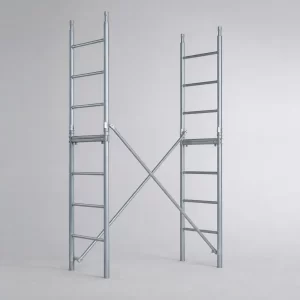
The rosette is welded to the standard at 500 mm centres, and each rosette carries eight slots, which means ledgers, transoms and diagonals can be connected at any angle in 45° increments. A forged wedge locks each component with a few hammer blows, and the same wedge is released just as quickly. This is what makes Ringlock the fastest system to erect and dismantle in the modular scaffolding family.
Technical Features of the Ringlock System
- Load capacity — vertical loads are transferred directly from the ledger into the standard through the rosette, giving high axial capacities; typical working loads for standard 48.3 x 3.2 mm uprights reach 50–60 kN at 2.0 m lift height.
- 8-way connection — up to eight components (including diagonals at any angle) can be locked into one node, so irregular geometries, curved facades and staircase towers are easy to build.
- Hot-dip galvanized finish — all components are HDG to EN ISO 1461 (average coating mass 450–550 g/m²), which suits long rental cycles and outdoor storage in Baltic climate conditions.
- Interchangeability — components are dimension-checked with gauges after galvanizing, so batches from different production runs assemble without forcing.
Applications on Polish and EU Projects
Ringlock is the preferred system for large facades, industrial maintenance, bridge and viaduct works, power plant shutdowns and any project where erection speed and load capacity pay back quickly. In Poland it is widely specified for facade renovation of historic tenement houses in Warsaw and Kraków, where the system’s flexibility around bay windows and architectural details is a real advantage, and for warehouse and hall construction across Mazowieckie and Wielkopolskie, where long runs of straight facade need minimal fittings. The system also works well as heavy-duty shoring when fitted with base jacks and U-head jacks, and for formwork support during slab casting.
Rental companies choose Ringlock because one component set serves both construction and event applications — stages, grandstands and temporary access for concerts and festivals can be built from the same inventory. For contractors, the lower labour cost per square metre of erected scaffold is the deciding factor on projects above 3,000 m².
Quality Assurance and Certification
Every Ringlock component is produced from certified tube (EN 39 / BS 1139 / ASTM A53) in our own pipe mills, welded with controlled procedures, 100% gauge-checked and hot-dip galvanized. Each shipment includes EN 10204 3.1 mill test certificates, load tables and erection instructions, plus the documentation needed for CE marking and compliance with EN 12811-1 and local safety regulations (in Poland, the requirements of Rozporz&261;dzenie Ministra Infrastruktury on temporary structures).
Packing, Delivery and Ordering
Components are bundled by size, palletized or container-packed with dunnage protection, and shipped from Tianjin or Qingdao to Gdańsk, Gdynia, Szczecin or any other Baltic / North European port in 15–25 days. Minimum order quantities start at one mixed pallet for loose components or one container for complete systems. Payment terms T/T, L/C. We prepare complete component lists with quantities from your facade area and working height, so you can order the exact set — no missing parts, no surplus.
Ringlock vs Cuplock vs Kwikstage — How They Compare
If you are choosing between modular systems, our detailed comparison article explains the differences in node design, erection speed, load capacity and cost — Ringlock vs Cuplock vs Kwikstage. In short: Ringlock offers the highest flexibility and load capacity, Cuplock is the fastest all-purpose system, and Kwikstage excels in standardized repetitive work. We supply all three, so the choice is based on your project, not on what we happen to stock.
Frequently Asked Questions
What is the maximum working height for a Ringlock scaffold?
With engineered base details and tie-in patterns, Ringlock towers are routinely erected to 60–80 m; higher structures require project-specific engineering and a design check by a qualified engineer in accordance with EN 12811.
Can Ringlock and Cuplock components be mixed?
No — the node systems are different (rosette/wedge vs cup/knuckle), so components are not interchangeable. We recommend standardizing on one system per project or rental fleet.
Do you supply Ringlock load tables and assembly instructions?
Yes, each system ships with load tables, erection and dismantling instructions, and the technical documentation needed for CE marking and local compliance.
What is the lead time for a full Ringlock set?
Standard components are produced and shipped within 15–25 days from order confirmation; large projects (multi-container) can be scheduled to match your site programme.
Component Maintenance and Service Life
Hot-dip galvanized scaffolding components are designed for decades of service with minimal upkeep. After each project, clean components of mortar and concrete residue, stack them by type on timber battens, and store them off bare ground so the zinc layer is not damaged. Where the coating is scratched through to the steel, touch up with zinc-rich paint before the next erection cycle. Rotating stock evenly and keeping one spare set of wedges or blades per 1,000 components keeps a rental fleet productive for 15–20 years — the same discipline that Polish rental companies apply to their own fleets.
Load Classes and Configuration Notes
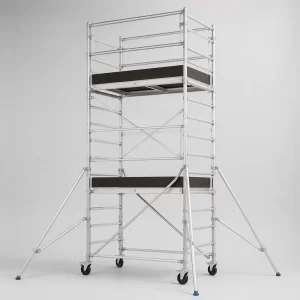
Scaffolding configurations are classified by load class according to EN 12811-1. Load class 3 (2.0 kN/m² distributed load) covers most facade renovation and finishing work; load class 4 (3.0 kN/m²) is used where materials are stacked on platforms; load classes 5–6 apply to heavy industrial and shoring duty. When you order a system, we confirm the load class with the bay layout, lift height and tie-in pattern, and provide the corresponding load tables. All systems can be configured as independent towers, facade scaffolds, birdcage supports or shoring structures simply by changing ledgers, transoms and ties — the same component pool covers all of them.
Why Buy Direct from Sino East Steel
Sino East Steel is a steel producer, not a trader: tubes for scaffolding components are rolled in our own mills, which gives us direct control over chemistry, wall thickness and surface quality, and keeps pricing at mill level. Since 2005 we have supplied Polish importers, distributors and contractors, and we maintain a bilingual (English / Polish) export team that prepares customs, certificates and shipping documentation from one source. Every order includes EN 10204 3.1 mill certificates, and for EU buyers we provide the technical file support needed for CE marking and EN 12811 compliance reviews.
Request a Quotation
To receive a factory-direct quotation, send your required component list (or facade area and working height), target port and quantity via the contact form, WhatsApp +86-186-2208-8833 or email [email protected]. Our export office responds within 24 hours with prices, load tables and a delivery schedule.
Component Lists for Complete Sets
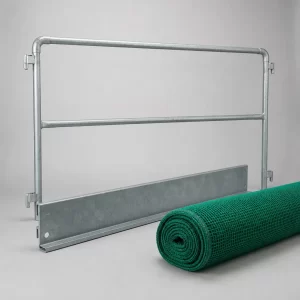
When you order a complete system set, the quantity list is calculated from three inputs: the facade area to be covered, the working height, and the load class. For a typical 1.2 x 2.0 m bay at 2.0 m lift height, a rough rule of thumb is 2.0–2.5 m of standard per square metre of facade, 0.5 ledgers per square metre per lift, plus transoms, boards, base jacks and ties proportionally. We prepare the exact list from your drawings or measurements, so the set arrives balanced — enough standards to reach the top, enough ledgers for every lift, and the right number of boards, guard rails and toe boards for every platform level. Spare wedges, blades and pins are added at 1–2% of the component count, which is the practical allowance rental fleets use to cover loss and damage.
Erection and Dismantling Practices
Whichever system you choose, safe erection follows the same sequence: level the base with jacks, erect the first bay and fit ledgers and diagonals immediately, check plumb and level, then build lift by lift with guard rails and toe boards fitted before anyone works at the new level. Ties are installed at the spacing given in the load tables — typically every 4–6 m of horizontal length and every 2–3 lifts vertically, or closer where wind exposure is high. During dismantling, components should be lowered rather than thrown, and the scaffold should be inspected after any storm, impact or load change. Our documentation package includes an erection checklist that site teams can use directly.
Transport and Storage
Galvanized scaffolding components transport and store efficiently because they are stackable and do not require weather protection beyond basic precautions. For container loading, standards and ledgers are bundled by length with steel strapping and timber dunnage; boards and frames are palletized; small items (couplers, wedges, bolts) travel in bulk bags or cartons. On site, keep components on timber battens off the ground, sorted by type, and cover bundles if they will sit through winter weather. With this routine, a set retains full load capacity and appearance for 15–20 years of rental service — which is why galvanized systems remain the standard for professional fleets in Poland and across the EU.
Compliance and Documentation for EU Buyers
For buyers in Poland and the EU, we provide the technical documentation needed to satisfy CE marking requirements and EN 12811-1 conformity reviews: design basis and load tables for each system, material certificates (EN 10204 3.1) covering tube chemistry and mechanical properties, galvanizing certificates to EN ISO 1461, and weld inspection documentation. Where the scaffold is supplied as a complete system for sale to end users, the declaration of performance and technical file can be prepared from the same documentation set. Our export team is familiar with Polish customs procedures for steel products, including the documentation required for EU safeguard measures and import controls, and will prepare the shipping documents accordingly.
Working with Sino East Steel on Your First Order
Starting a relationship with a new supplier should be low-risk. On your first order we can agree a pre-production sample batch (for couplers, jacks or small components), arrange third-party inspection (SGS or similar) before shipment at your cost, and split a container shipment if you want to test the market with a smaller volume first. Payment by T/T with deposit and balance against shipping documents, or by irrevocable L/C, both work. After the first order, repeat orders benefit from fixed price windows of 30–90 days and reserved production slots, so your rental or construction schedule is not exposed to price swings.
Selection Support and After-Sales
Choosing between systems and sizing the set is easier with an engineer on the other end of the line. Our export team includes engineers who work daily with Polish and EU contractors, so we can recommend the system, calculate quantities, confirm load classes and review your tie-in pattern before production. After delivery, we support the first erection with remote guidance, provide spare parts and additional components from the same production batch codes, and can adjust a repeat order to match what your site actually consumed. You are not buying components from a catalogue — you are getting a configured system with engineering backup behind it.